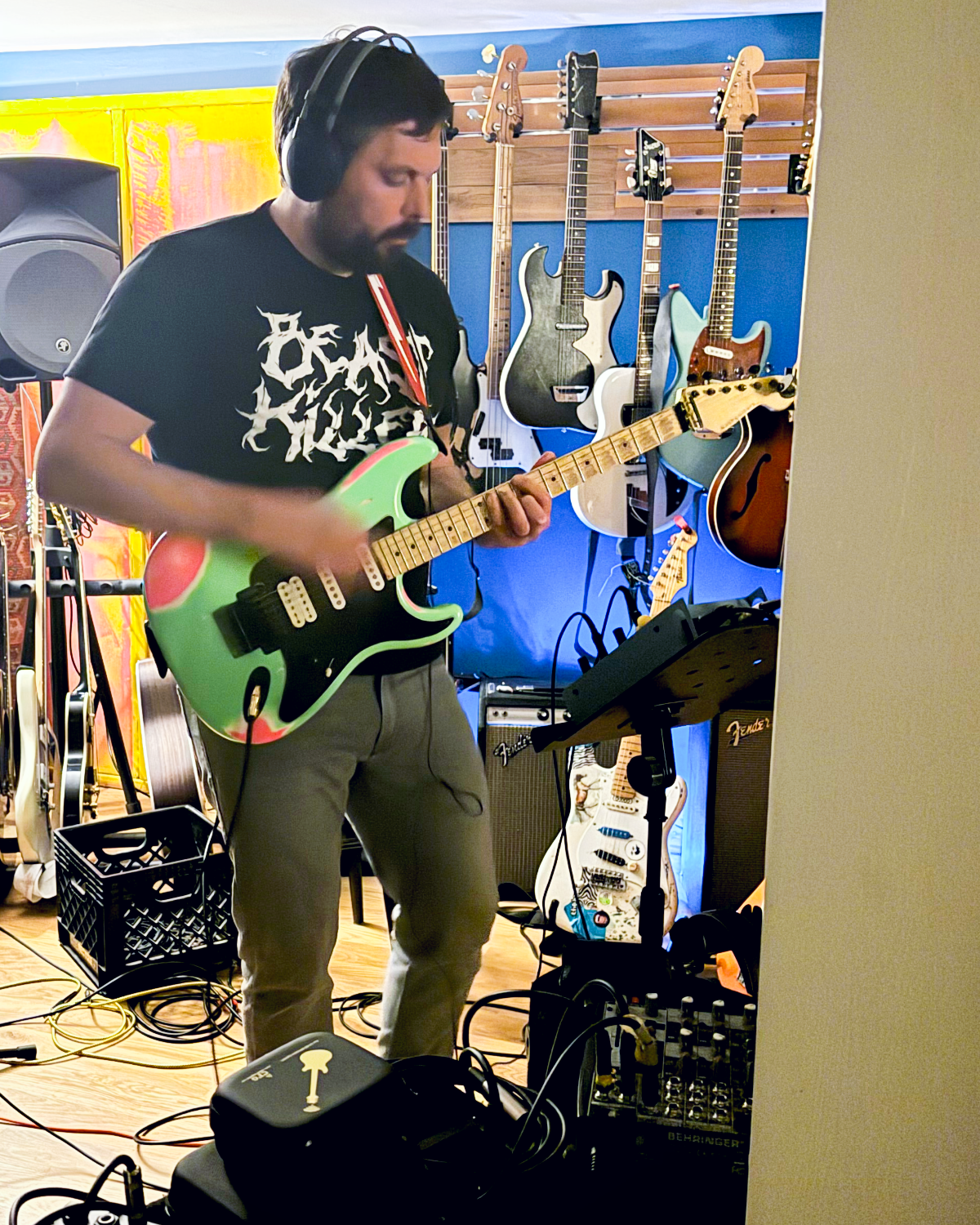
My parents gifted me an acoustic guitar the Christmas of my 13th year. For the past 30 years, I have been trying to write rock music. I liked the way Jimmy Page's guitar sounded. I liked grunge like Nirvana and Pearl Jam. I started getting into punk rock in the late '90s and early 2000s: Face to Face, NOFX, Jawbreaker, and Bad Religion. Then I found the more mature sound of the DC scene led by Fugazi, Rites of Spring, Jawbox, and Dag Nasty. One thing was common across all of those bands: the tone knob on the guitar was always fully open.
I spent 30 years writing songs and riffs with the tone knob open. I never thought I needed to do anything different. I liked that tone, and it sounded like the music I liked.
Last week I was back in the studio in Nashville recording some new rock songs. I recently met a talented musician, Zach Grace, who played in one of my favorite bands, Mock Orange. He records artists out of his home, and we were able to book some time with him. I was laying down some lead riffs, and I wanted to get a cool tone I'd heard on a Mock Orange record — where the guitar sounded like an analog synth, big and round. Zach said, "Oh yeah, that's just a blues driver with the tone knob all the way down."
I was pretty shocked. That seemed too easy. He went into his pedal stash, brought out the blues driver, and plugged it in. He told me to turn down the tone knob, and I started playing the riff. A few turns of the amp knobs later, and there it was. I was so happy I laughed like one of my children. Zach said, "Do you want to give it a try?" and I took a shot. What ensued was some of the most fun I've had in a studio.
I immediately thought of Veil Genomics.
Scaled long-read sequencing might sound strange to some researchers. For years, we've seen publications built on one genome — maybe two or three. We see papers with dozens of authors showcasing a dozen genomes, maybe two dozen. Population-scale long-read sequencing just doesn't cross most people's minds. It's like the tone knob being turned all the way down: it's right there, and nobody's reaching for it.
There are so many situations where scaled long-read sequencing is exactly the tone you need. Consider this scenario in plant breeding. In a program that uses genomic selection with known founders, those founders are typically sequenced at high depth with short reads. The goal is to generate high-resolution genotype information that can be used to improve imputation of genotypes across the breeding population. Cheaper genotyping with imputation allows a program to genotype tens of thousands of individuals — and that's what makes genomic selection work at scale.
Everyone agrees that's the right approach, right? It sounds like a lead off a Pearl Jam album.
It's actually not the right approach. There's a different way. Instead, you could generate lower-coverage long-read sequencing data on those founders. It would cost less per sample — if you don't believe me, ask for a quote from Veil — and it would give you better information. Longer reads. Phased variant calls. Larger structural variation, and the variants linked to those structural variants. The true value proposition: you pay less per insight. The cost per impactful data point is lower.
A great showcase of this is currently in review and was published as a preprint by Veil Genomics co-founder Kendall Lee, PhD. You can read it here → https://www.biorxiv.org/content/10.1101/2025.01.09.632261v1
Sometimes the tone you need is not the tone you think is right. Sometimes it's right there at your fingertips — literally — and you never knew it.
You do now.
And if you're itching to hear exactly what I mean, the clip of one of those leads is below. It's not mixed, and there aren't vocals yet, but you'll hear what made me so happy. It's rad.